

“AI Disruption” Publication 8400 Subscriptions 20% Discount Offer Link.
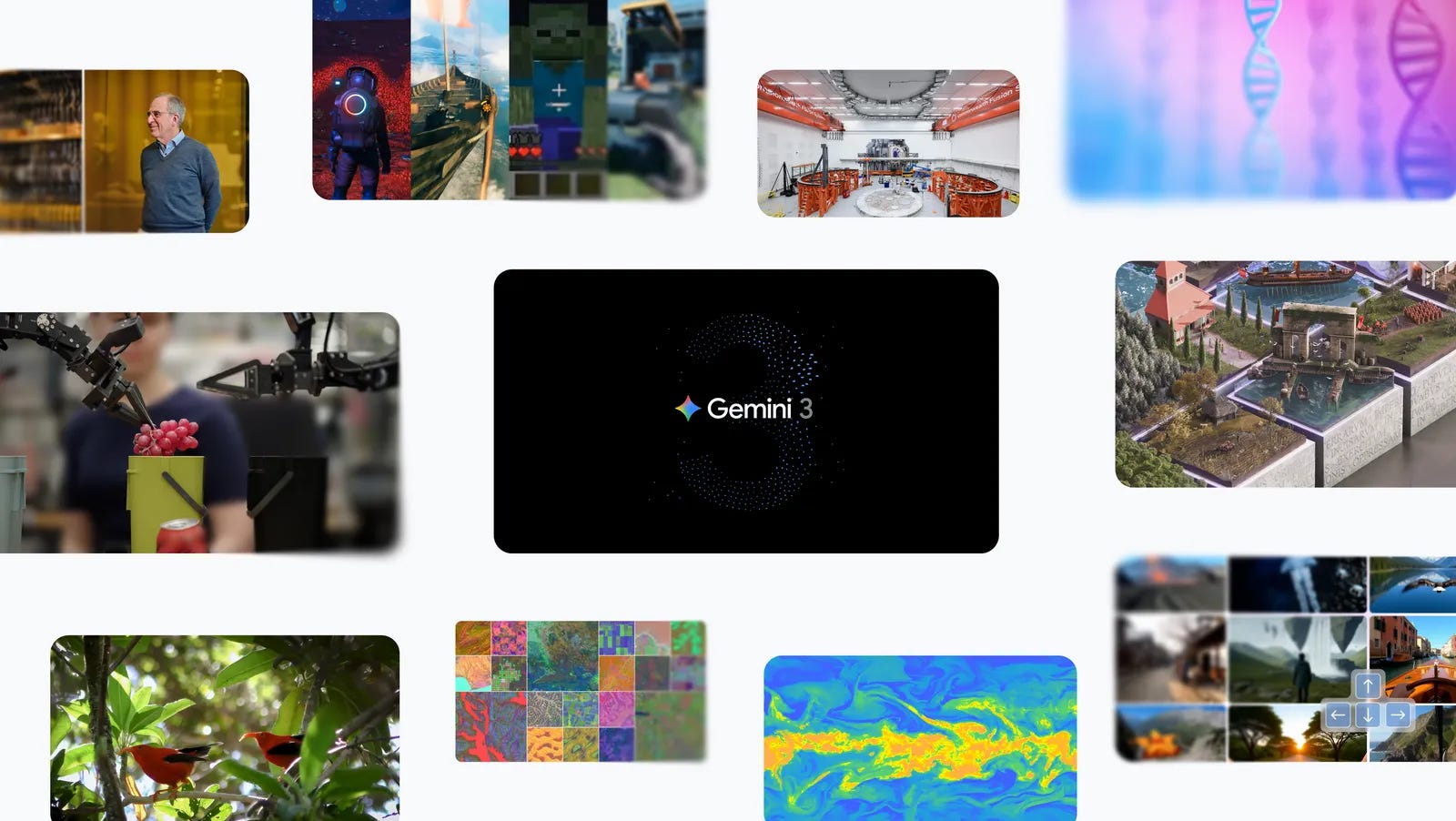
As 2025 draws to a close, Google has delivered an impressive report card in the field of artificial intelligence.

Once questioned for “publishing Transformer yet losing the first-mover advantage,” Google was caught in the whirlpool of public opinion about “falling behind in large language models.” But this year, Google fought back beautifully with a series of milestone releases. It proved to the world that AI is no longer just a chatbot companion, but has become a “partner” capable of writing code, conducting scientific research, and even tackling cutting-edge scientific challenges.
Looking at the year-end report card shared by Demis Hassabis, with Gemini 3, Genie 3, Veo 3, Nano Banana... the achievements are indeed fruitful.

Before diving into details, let’s quickly review Google’s major “killer features” this year:
Model Front: Gemini 3 rose to dominance, breaking records in logical reasoning and mathematical capabilities, with the Flash version surpassing previous Pro models in cost-effectiveness.
Hardware Front: The seventh-generation TPU Ironwood saw explosive computational power growth, targeting NVIDIA; quantum computing achieved a “quantum echo” breakthrough.
Application Front: AI is no longer just a chatbot—it’s reshaping programming through Antigravity, and completely transforming video generation and world simulation through Veo 3 and Genie 3.
Scientific Front: AlphaFold’s fifth-anniversary milestone and Nobel Prize in Chemistry double coronation established a leading position in AI for Science. Gemini Deep Think also achieved gold medal levels in both the International Mathematical Olympiad (IMO) and International Collegiate Programming Contest (ICPC), marking a qualitative leap in AI’s abstract reasoning capabilities.
Here’s our detailed technical review:
