

“AI Disruption” Publication 8400 Subscriptions 20% Discount Offer Link.
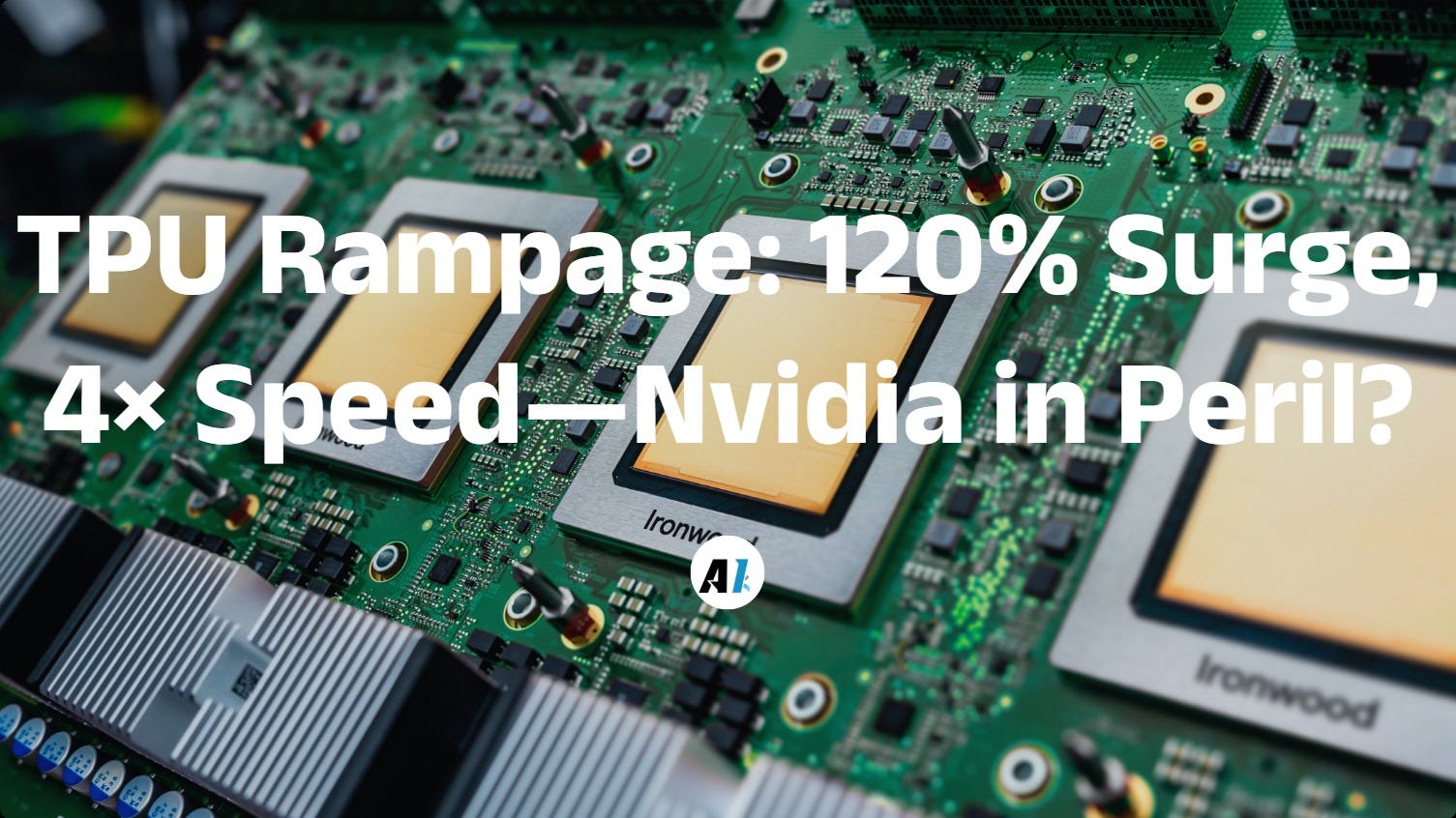
Is Nvidia’s “Moat” Collapsing? Why Are Tech Giants Frantically Defecting to Google TPU?
Google is getting serious this time.
Morgan Stanley’s latest research report revealed a major development: Google TPU’s production capacity is about to experience explosive growth. More critically, signals from the supply chain indicate that uncertainty around TPU supply has essentially been resolved, meaning Google can now freely sell chips externally.
Morgan Stanley directly raised its forecasts sharply. TPU production will reach 5 million units in 2027 and surge to 7 million units in 2028. Previously, forecasts were 3 million and 3.2 million units, representing upward revisions of 67% and 120% respectively. In other words, Google will produce 12 million TPUs over the next two years, compared to just 7.9 million produced over the past four years.
How profitable is this business? Morgan Stanley estimates that for every 500,000 TPU chips Google sells, it could generate approximately $13 billion in revenue in 2027, adding $0.40 to earnings per share.
From a strategic perspective, Google’s approach is clear: directly selling TPUs to third-party data centers as an important complement to its Google Cloud Platform (GCP) business. Although most TPUs will still be used for Google’s own AI training and cloud services, such a large production capacity reserves clearly indicate preparation for broader commercialization.
Morgan Stanley believes these signs are early signals of Google’s TPU sales strategy. With explosive demand for advanced AI computing power across the industry, Google clearly doesn’t want to miss this opportunity.
Influenced by strong AI chip demand, Morgan Stanley also upgraded MediaTek’s rating to “Overweight,” citing benefits to the entire chip supply chain.
Nvidia’s dominance in the AI chip market may finally face a real challenger.
Recently, the technical competition between Google TPU and Nvidia GPU has become a hot topic in the industry.
In the fierce battle for AI supremacy, Nvidia has long held the dominant position. Its GPUs have driven explosive growth in machine learning, transformed abstract neural networks into reality, and built a multi-trillion-dollar business empire. But as the AI landscape evolves, cracks are beginning to appear in Nvidia’s “armor.”
The market is being reshaped from model training (Nvidia’s strength) to inference (the real-time application of these models). Leading this transformation is Google’s Tensor Processing Unit (TPU), which may end Nvidia’s monopoly with its unparalleled efficiency and cost advantages.
By 2030, inference will consume 75% of AI computing resources, creating a $255 billion market growing at 19.2% annually. However, most companies still optimize for training costs.
