


“AI Disruption” Publication 10,500 Subscriptions 20% Discount Offer Link.
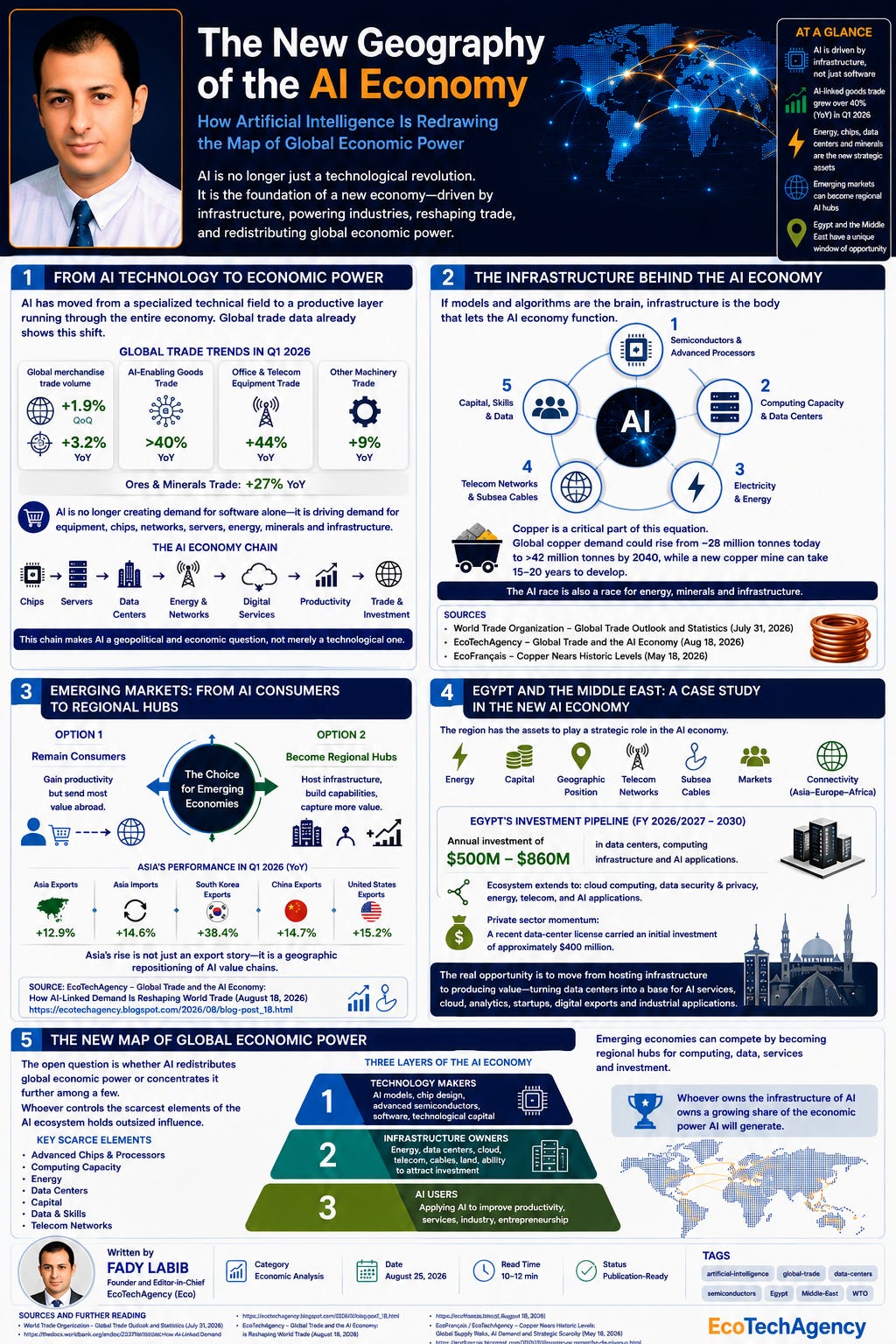
Artificial intelligence is no longer simply a technological revolution measured by the capability of language models or the speed of application development. As AI moves from laboratories and tech companies into industry, energy, finance, trade, and services, a new economy is taking shape around it, with its own infrastructure, supply chains, centers of power, and capital and geographic requirements.
The old question - who owns the best AI model? - is giving way to a more consequential one: who has the capacity to build and operate the infrastructure that makes AI possible at scale?
That capacity is determined not only by software, but by chips and semiconductors, computing power, data centers, energy, telecom networks, capital, data, and human skills. Seen this way, AI is not merely a technological shift, it is a force capable of redrawing the distribution of global economic power.
1. From AI Technology to Economic Power
AI began as a specialized technical field. It is becoming a productive layer running through the entire economy, and global trade data already shows it.
According to the World Trade Organization, global merchandise trade volume rose 1.9% in Q1 2026 quarter-on-quarter and 3.2% year-on-year. Over the same period, trade in AI-enabling goods jumped more than 40% year-on-year, while trade in office and telecommunications equipment rose about 44%.
These figures matter because they show AI is no longer generating demand for software alone, it is generating demand for equipment, chips, networks, servers, energy, minerals, and infrastructure. While some traditional goods categories declined, trade in other machinery rose about 9%, ores and minerals 27%, and office and telecom equipment 44%.
AI is now moving through a full economic chain: chips → servers → data centers → energy and networks → digital services → productivity → trade and investment.
That chain is what makes AI a geopolitical and economic question, not merely a technological one.
2. The Infrastructure Behind the AI Economy
If models and algorithms are the brain of the AI economy, infrastructure is the body that lets it function. Five interconnected elements make up that body:
• Semiconductors and advanced processors
• Computing capacity and data centers
• Electricity and energy
• Telecommunications networks and subsea cables
• Capital, skills, and data
Data centers have become a strategic economic asset, not a technical facility. Generative AI models require enormous computing power, and the data centers behind them require electricity, connectivity, cooling, cybersecurity, and heavy capital investment.
One overlooked piece of this puzzle is minerals. The expansion of data centers, networks, renewable energy, and electric vehicles is driving demand for copper and other critical minerals, global copper demand could rise from roughly 28 million tonnes today to more than 42 million tonnes by 2040, while a new copper mine can take 15 to 20 years to develop. The AI race, in other words, is also becoming a race for energy, minerals, and infrastructure.
3. Emerging Markets: From AI Consumers to Regional Hubs
Emerging economies face a choice. They can remain consumer markets for AI technologies built in the United States, China, and elsewhere, or invest in infrastructure, skills, capital, and regulation to become regional AI hubs.
A country that only consumes AI tools gains productivity but sends most of the value abroad. A country that hosts data centers, provides computing capacity, builds startups, trains talent, and connects neighboring markets captures a much larger share of the value the AI ecosystem generates.
Asia is already positioning itself as a major beneficiary. Per WTO data, Asia’s exports rose 12.9% year-on-year in Q1 2026 and imports rose 14.6%; South Korea’s exports rose 38.4%, China’s 14.7%, and the United States’ 15.2%, all reflecting rising demand for AI-linked electronics and equipment. Asia’s rise, then, is not just an export story. It is a geographic repositioning of AI value chains.
4. Egypt and the Middle East: A Case Study in the New AI Economy
Egypt and the wider Middle East offer a useful test case. The region holds a combination of assets that matter in an AI economy: energy, capital, geographic position, telecom networks, subsea cables, markets, and the ability to connect Asia, Europe, and Africa.
Egypt’s position and subsea cable infrastructure - linking major routes between the Mediterranean and the Red Sea - are a real source of strength. Under President Abdel Fattah El-Sisi, Egypt has begun treating data centers and cloud computing as core future economic infrastructure. EcoTechAgency’s own review of the investment pipeline points to annual spending of $500 million to $860 million between fiscal year 2026/2027 and 2030 on data centers, computing infrastructure, and AI applications.
These investments extend beyond physical facilities into a broader ecosystem covering cloud computing, data security, privacy, energy, telecommunications, and AI applications. The private sector is also entering more forcefully, one recent data-center license carried an initial investment of roughly $400 million.
The real test for Egypt and the region is whether they can move from hosting infrastructure to producing value: turning data centers into a base for AI services, cloud computing, analytics, digital financial services, industrial applications, startups, and digital exports. If that happens, geography shifts from a logistical advantage into a digital and economic one.
5. The New Map of Global Economic Power
The open question is whether AI redistributes global economic power or concentrates it further among a small number of countries and companies. The answer isn’t settled yet, but whoever controls the scarcest elements of the AI ecosystem (advanced chips, computing capacity, energy, data centers, capital, data, skills, telecom networks) holds outsized influence over the global economy.
That dynamic explains the rise of China, South Korea, Taiwan, and Singapore, alongside the continued dominance of the United States in software, capital, and advanced technology companies. But the picture isn’t limited to major powers. Emerging economies - Egypt, the Gulf states, India, and other Asian markets - can still compete, not by producing every AI component, but by becoming regional hubs for computing, data, services, and investment.
AI Is Redrawing Supply Chains
2026 trade data illustrates the shift clearly. Even as some energy and shipping routes suffered severe disruption, technology- and AI-linked trade kept growing. WTO figures show global crude oil imports from the Middle East fell about 45% year-on-year in March, LNG imports fell about 52%, and fertilizer imports fell 26%, while trade in office and telecom equipment rose about 44%.
This isn’t a story about AI “rescuing” global trade from crisis. It’s a story about the composition of trade itself changing. Demand is shifting away from oil, steel, and traditional goods toward chips, servers, networks, electrical equipment, minerals, and data-center components, meaning trade geography will increasingly track computing geography.
More than reshaping the movement of goods, AI is reshaping value chains. Higher-value activity is migrating toward countries that hold:
• Chip and processor design
• Semiconductor manufacturing
• Advanced computing centers
• AI models
• High-quality data
• Software and services
• Capital
• Talent and skills
• Reliable, low-cost energy
The defining question is no longer just where are products made, it’s where is the capacity to run the intelligence that makes an economy more productive?
This creates a new divide. Countries with infrastructure, skills, and capital attract more investment, which drives more demand for energy, data, and talent, which attracts still more investment. Countries left outside this loop risk becoming permanent consumers of imported technology.
What Entrepreneurship Research Says About This Shift
This macro picture lines up with recent firm-level research. A 2025 study in Future Business Journal by Yaser Hasan Al-Mamary examined how AI capabilities affect entrepreneurial venture success, surveying 327 entrepreneurs in Saudi Arabia and analyzing the data with structural equation modeling in SmartPLS.
The study found statistically significant effects of AI capabilities on decision-making, innovation, risk mitigation, and competitive advantage, but no significant effect on automation or customer experience within the model tested.
That finding matters because it reframes AI as more than a cost-cutting or automation tool. It suggests AI capability itself is becoming a strategic asset shaping how companies decide, innovate, manage risk, and build competitive advantage.
The New Economic Map: Three Layers of Power
The AI race isn’t reducible to a contest between models: ChatGPT, Gemini, DeepSeek, or any other. It’s a race for the economic capacity underlying those models. The global AI economy can be read as three interconnected layers:
Layer 1 — Technology Makers: countries and companies that own AI models, chip design, advanced semiconductors, software, and technological capital.
Layer 2 — Infrastructure Owners: those controlling energy, data centers, cloud computing, telecom, subsea cables, land, and the ability to attract investment.
Layer 3 — AI Users: economies applying these technologies to improve productivity, services, industry, and entrepreneurship.
AI alone does not guarantee a redistribution of global economic power. If advanced chips, computing capacity, capital, models, and data centers stay concentrated among a small number of countries and companies, AI will likely deepen existing concentration. But if emerging markets build infrastructure, develop skills, attract capital, secure energy and connectivity, and convert data into services, companies, and economic value, AI becomes an opportunity to redraw the map instead.
This is where Egypt and the Middle East’s importance lies. The coming competition may not be about who owns the largest AI model, it may be about who secures the best position within the global AI economy. Data centers, energy, subsea cables, semiconductors, capital, skills, and entrepreneurship are all pieces of one interconnected question:
Whoever owns the infrastructure of AI owns a growing share of the economic power AI will generate.
Sources and Further Reading
World Trade Organization — July 31, 2026: Global goods trade resilient in the first quarter of 2026 despite war in Middle East
World Trade Organization — March 2026: Global Trade Outlook and Statistics
Al-Mamary, Y.H. (2025), Future Business Journal, 11, 104: The transformative power of artificial intelligence in entrepreneurship | DOI: 10.1186/s43093-025-00533-7
Egypt data-center investment pipeline: EcoTechAgency analysis (agency analysis; figures should remain attributed to EcoTechAgency unless independently verified).
Additional EcoTechAgency Analysis
• EcoTechAgency analysis — Global Trade and the AI Economy, August 18, 2026. https://ecotechagency.blogspot.com/2026/08/blog-post_18.html
• EcoFrançais / EcoTechAgency analysis — Copper and Strategic Supply Risks, May 18, 2026. https://ecofrancais.blogspot.com/2026/05/le-cuivre-se-rapproche-de-niveaux.html
AI Economy Geography is only the beginning of a much larger conversation about how AI will reshape global economic power.
EcoTechAgency is grateful to AI Disruption for this fruitful collaboration. Wishing the team continued growth, success, and prosperity.