“AI Disruption” Publication 10,500 Subscriptions 20% Discount Offer Link.
New models keep appearing one after another, almost as if each is desperate to prove to the world that it can write and chat. Yet the one that has recently drawn the most attention and flooded timelines is Jev.
It does not speak.
Diogo Almeida is a researcher at OpenAI. He worked on ChatGPT and later helped introduce reinforcement learning from human feedback (RLHF). In some sense, that approach defined the direction of large language models over the past few years. But even as the method helped push the entire industry into a boom, Almeida grew increasingly skeptical of it.
“We had a one-shot innovation, but we never turned it into something truly useful.”
It took him a long time to see where the problem was: we had been optimizing for the processing of human language. For four years, we became extremely good at handling human language. That is not very useful for automation, because computers use a different “language.”
Two years ago, Almeida left OpenAI and co-founded TypeSafe AI with Erik Gafni and Sasha Sheng. The company stayed in stealth until September 15, when it officially launched and announced two things: a $40 million seed round led by DCVC, and its first model, Jev.
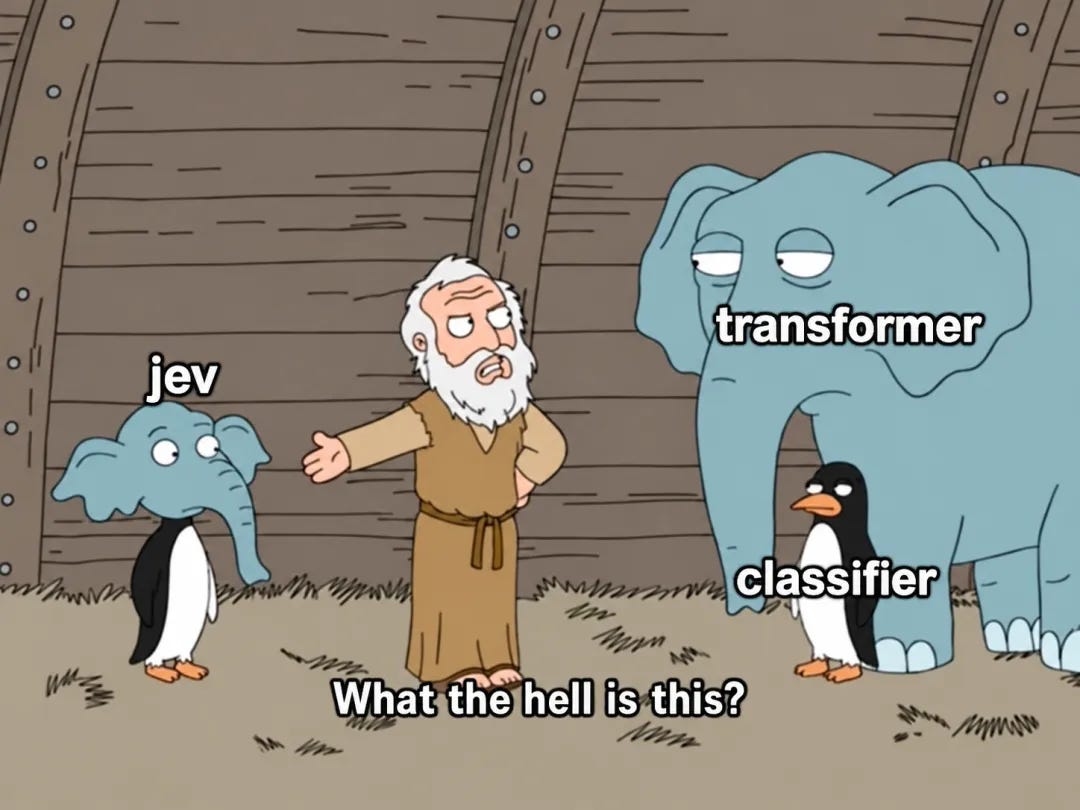
Jev is still a Transformer-based model, but it is deliberately not a large language model. It does not output a complete sentence.
You give it a program state and a predefined question. What it returns is a typed answer: a choice, a score, or a probability between 0 and 1, plus a confidence score.
TypeSafe calls this kind of output a “calibrated decision.” That is also why many people were confused the first time the name Jev entered public view.