

“AI Disruption” Publication 10,300 Subscriptions 20% Discount Offer Link.
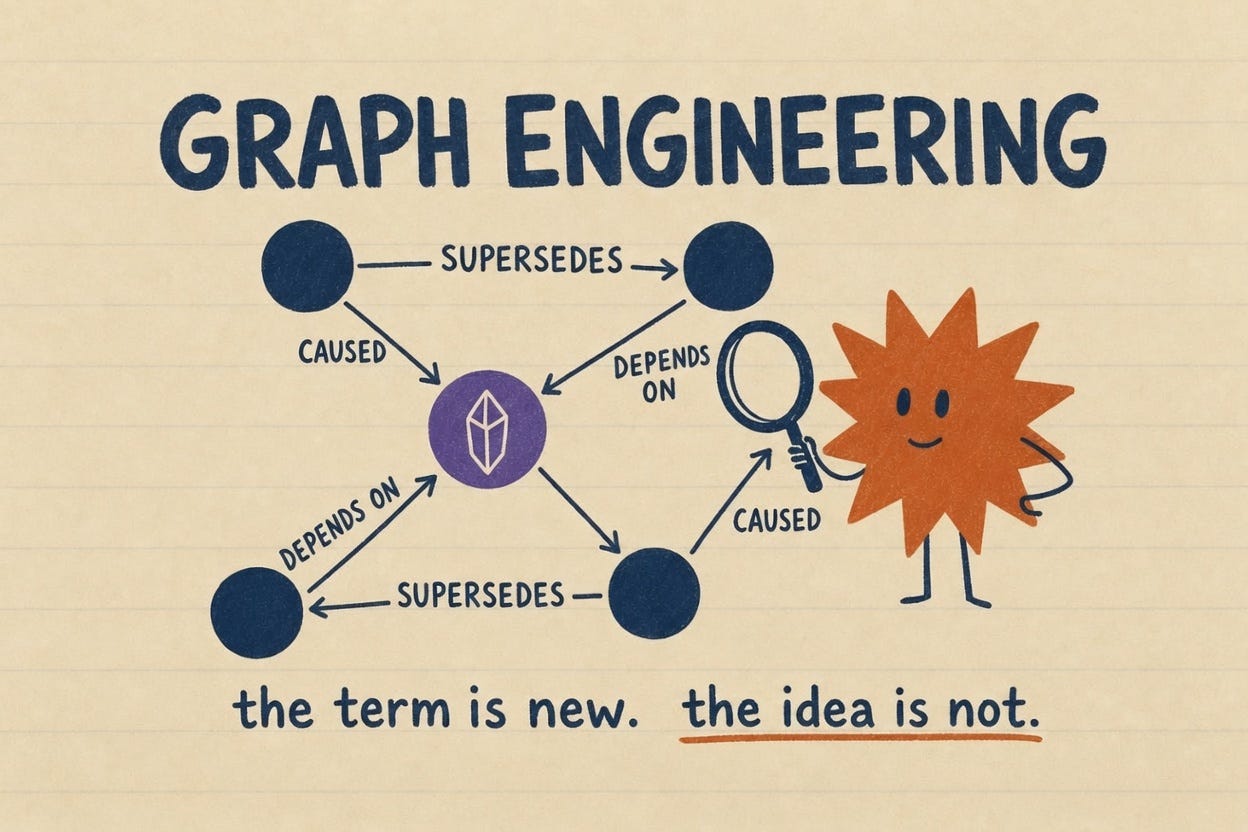
Lately, the term Graph Engineering has been popping up a lot. Many people’s first reaction is: here comes another buzzword. In reality, it’s not mysterious at all—in fact, it’s a bit down-to-earth and can be explained in just a few sentences.
Looking at it from the perspective of writing prompts makes it even simpler, because at its core it’s still just a particular way of writing within prompt engineering:
Graph Engineering is about rewriting complex tasks from a linear list of steps into a graph composed of task nodes and dependency relationships.
Starting from the 1-2-3-4 Workflow
When we write task-oriented prompts, we easily end up with something like this:
1. Analyze the project structure
2. Check the runtime logs
3. Formulate an optimization plan
4. Modify the code
5. Run tests
This style is simple, clear, and matches the human habit of writing operation manuals.
But it carries an implicit assumption that the five tasks execute linearly:
Step 2 must wait for step 1 to finish, step 3 must wait for step 2 to finish.
Real-world complex tasks are rarely like that. The actual task relationships are often closer to:
Analyze project structure ─┐
                           ├─ Formulate optimization plan ─ Modify code ─┬─ Unit tests ─┐
Check runtime logs ───────┘                                           └─ Performance tests ─┴─ Done
Analyzing the project structure and checking the runtime logs usually have no dependency on each other and can run in parallel. Only after both analyses are complete can the optimization plan be formulated. After the modifications are done, unit tests and performance tests can again execute in parallel.
By reorganizing the tasks along the real path, the before-and-after dependencies become much clearer. That is the core of Graph Engineering.
